There is something deeply exhausting about trying to prove that you are enough. Whether we admit it or not, many of us spend our lives trying to earn acceptance. We work harder at our jobs hoping someone will notice. We try to become better parents, better spouses, or better friends because we fear falling short. Even in our relationship with God, we often carry the quiet burden of believing that if we pray a little more, serve a little more, or overcome one more weakness, perhaps then He will be pleased with us.
It is a subtle way of thinking, but it can slowly shape our entire view of the Christian life. We begin measuring our worth by our spiritual performance. On days when we feel strong, we believe God must surely be pleased with us. On days when we stumble, we quietly wonder if we have disappointed Him. Without realizing it, we turn our eyes away from Christ and begin looking at ourselves.
Saved by Grace Through Faith
The Apostle Paul speaks directly into this struggle with one of the most comforting truths in all of Scripture. In Ephesians 2:8-9 he writes,
For it is by grace you have been saved, through faith and this not from yourselves, it is the gift of God, not by works, so that no one can boast.
These verses have brought peace to countless hearts throughout history because they remind us that salvation has never depended on human effort. It begins and ends with God. Long before we ever reached for Him, He reached for us. Long before we ever believed, Christ had already gone to the cross. Long before we ever understood our need for a Savior, God had already made a way for us to be reconciled to Him.
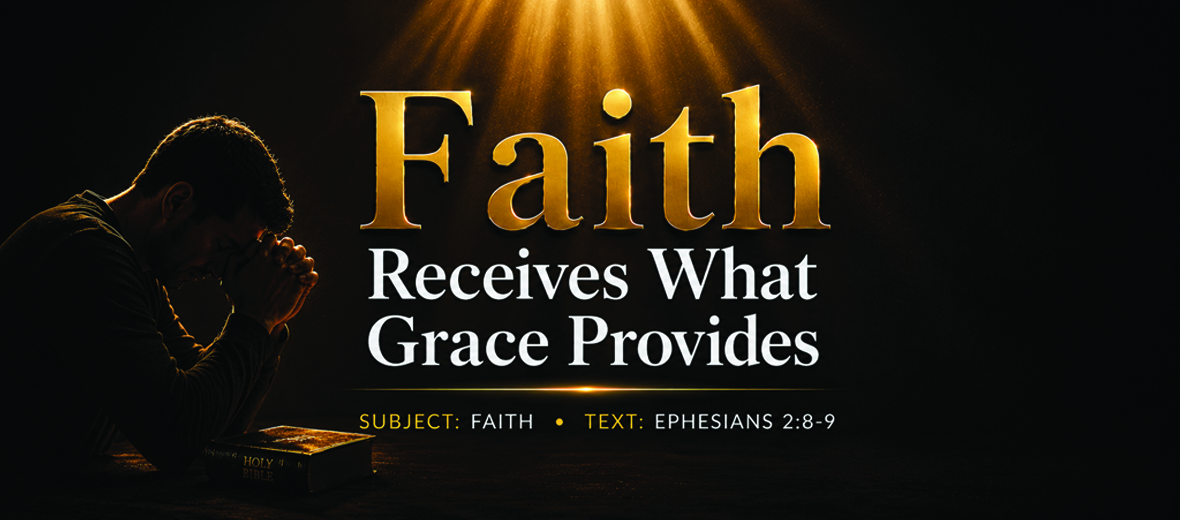
That is why the title of this message is so important: Faith Receives What Grace Provides.
Faith Is the Open Hand
Notice that Paul begins with grace, not faith. That order is intentional. Grace is the source. Faith is simply the means by which we receive what God has already accomplished. Faith does not improve God’s grace. It does not strengthen Christ’s finished work or complete something that was lacking. Faith is not another ingredient added to salvation. Instead, it is the open hand that receives the gift God freely offers.
This is why I so strongly emphasize that we have done absolutely nothing to earn our salvation. Some may wonder why this point deserves so much attention. After all, if we have believed in Christ, does it really matter whether we think we contributed something?
It matters because the human heart has an incredible ability to find reasons to boast. Even after receiving salvation, our sinful nature looks for something it can claim as its own. Pride has a way of quietly entering places where we least expect it, even into our faith.
A Gift Cannot Be Earned
Have you ever noticed how easy it is for our thoughts to drift in that direction? We may never say these words out loud, but sometimes we think, “God accepted me because I believed.” Or perhaps we quietly compare ourselves with others and think, “I was wise enough to choose Christ while others rejected Him.” Sometimes it becomes even more subtle. We begin to believe, “My faith is what makes me worthy.”
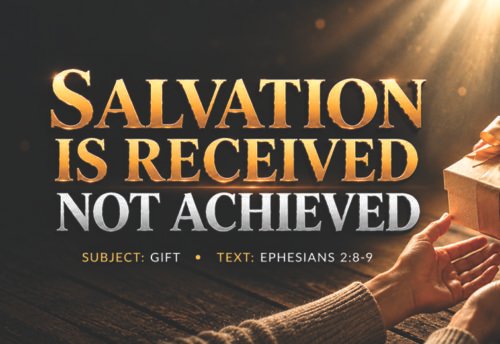
At first glance, these thoughts may sound harmless, but they slowly shift the focus away from God’s grace and place it on human ability. Instead of marveling at what Christ has done, we begin admiring our own response to Him. The center of the story quietly changes. Christ becomes smaller while our role becomes larger. Paul removes every possibility for that kind of pride. He tells us that salvation is God’s gift. A gift is never earned. It cannot be purchased, negotiated, or deserved. It can only be received.
Imagine someone placing a beautifully wrapped gift into your hands on your birthday. You would never boast about receiving it as though opening the package somehow earned what was inside. The value of the gift belongs entirely to the one who gave it. Your only role was to receive it with gratitude.
Salvation is infinitely greater than any earthly gift, yet the principle remains the same. God is the Giver. Christ paid the full price. Grace made salvation possible. Faith simply receives what grace has already provided. This truth leaves no room for boasting, only worship.
True Faith Produces Humility
James reminds us of this when he writes, “God opposes the proud but gives grace to the humble” (James 4:6). Pride always seeks recognition. It wants to claim credit, even for spiritual things. Humility, however, gladly acknowledges that every good thing comes from God.
True faith always produces humility because genuine faith recognizes its own helplessness. Faith does not stand before God saying, “Look what I accomplished.” Instead, it falls at the feet of Jesus saying, “Without You, I have nothing.”
There is something profoundly freeing about admitting that. Many believers spend years trying to carry a burden Christ never asked them to bear. They constantly wonder whether they have enough faith, whether they have done enough good works, or whether God still accepts them after another failure. Yet the Gospel gently invites us to lay down those burdens and rest in Christ.
Perhaps one of the most beautiful prayers we could ever pray is simply this:
Lord, You have saved me and given me rest. I now place myself in Your hands. Here I am. Take me and do with me whatever pleases You.
Notice what that prayer does not say. It does not bargain with God. It does not promise to earn His love. It does not try to impress Him. It simply surrenders to the One who has already done everything necessary for our salvation.
If grace is the source of salvation, then what exactly is faith?
The Meaning of Pistis
The New Testament uses the Greek word πίστις (pistis). This word carries the idea of persuasion, conviction, confidence, reliance, and trust. It describes a heart that has become fully convinced that God is trustworthy. Faith is not blind optimism or wishful thinking. It is a settled confidence that rests entirely upon the character and promises of God.
This raises another important question. How does a person become persuaded? Paul answers that question in Romans 10:17:
“So faith comes from hearing, that is, hearing the Good News about Christ.”
Faith grows as we hear God’s Word.
Every time you open your Bible with a humble heart, every time you faithfully sit under biblical preaching, every time you meditate on the promises of God, your heart is being persuaded again. God’s truth slowly reshapes the way you think. Fear begins to lose its grip. Doubt starts giving way to confidence. Anxiety slowly surrenders to trust. Not because your circumstances have changed, but because your heart is becoming increasingly convinced that God is exactly who He says He is.
This is why spending time in God’s Word is not merely another religious habit to check off a list. It is the very means by which God strengthens your faith.
Peter understood this well when he wrote,
“As newborn babes, desire the sincere milk of the word, that ye may grow thereby.
Just as an infant cannot grow without nourishment, neither can our faith mature apart from God’s Word.
Sadly, one of the greatest dangers believers face today is not outright rejection of Scripture but constant distraction from it. Our lives are filled with endless notifications, busy schedules, entertainment, responsibilities, worries, and countless voices competing for our attention. Days pass quickly, and before we realize it, we have spent hours listening to everything except the One voice that gives life. Then we wonder why our faith feels weak. Faith cannot grow where God’s Word is neglected.
Every time you hear the sweet, life-giving Word of God, your heart is persuaded a little more. Every promise you read reminds you that God is faithful. Every story of His goodness strengthens your confidence in Him. Every truth you meditate on becomes another reason to trust Him tomorrow.
From Self-Reliance to God-Reliance
Do not allow the troubles, distractions, or temptations of this world to keep you from hearing God’s Word. The world will always compete for your attention, but only God’s Word can persuade your heart to trust Him more deeply. As our faith grows, something else begins to change. We slowly let go of our dependence on ourselves.
This may be one of the hardest lessons we will ever learn because self-reliance feels so natural. We like believing that if we work hard enough, plan carefully enough, or become disciplined enough, we can control the outcome of our lives. While responsibility and diligence are good, they become dangerous when they replace dependence upon God.
Faith says something entirely different. Faith says, “What I cannot provide, God has already provided.” Paul beautifully expressed this in Philippians 3:8 when he wrote, “What is more, I consider everything a loss compared to the surpassing greatness of knowing Christ Jesus my Lord… I consider them rubbish, that I may gain Christ.”
Imagine how radical those words must have sounded. Paul had every reason to boast in his religious achievements, yet he gladly laid them all aside because he discovered something infinitely greater. Knowing Christ was worth more than everything he had once trusted. The same invitation is extended to us.
Self-reliance says, “I can handle every problem by myself. My success depends entirely on me.” Faith replies, “I will work faithfully, but I trust God for the wisdom, strength, and outcomes that are beyond my control.” That kind of faith brings rest to the soul.
The world tells us that strength comes from believing in ourselves. Scripture teaches something entirely different. It tells us that true strength comes from believing in Christ. It takes faith to admit that we cannot save ourselves. It takes faith to confess that we need God’s grace every single day. It takes faith to surrender control and place our future into His hands.
Ironically, the more mature our faith becomes, the less we boast about having faith. Mature faith does not draw attention to itself. It continually points to Jesus. When people leave our presence, they should not be impressed by how spiritual we appear. They should be impressed by how wonderful our Savior is.
That is the beauty of the Gospel. It leaves us with nothing to boast about except Christ. It teaches us that every blessing we enjoy flows from His grace. Every promise we cling to rests upon His faithfulness. Every hope we possess was purchased by His sacrifice. All glory belongs to Him.
Rest in What Christ Has Done
Perhaps today you have been carrying the heavy burden of trying to earn what God has already chosen to give freely. Maybe you have spent years trying to prove yourself worthy of His love. Friend, hear the gentle invitation of the Gospel once again. Stop striving to achieve what Christ has already accomplished. Rest in the finished work of Jesus. Open your heart to receive what God’s grace has already provided.
Faith does not earn salvation. Faith receives it. And when you truly understand that, your heart will no longer be filled with pride over what you have done. Instead, it will overflow with gratitude for what Christ has done on your behalf.
Heavenly Father, thank You that my salvation rests entirely upon Your grace and not upon my own efforts. Forgive me for the times I have trusted in myself or taken pride in what only You could accomplish. Continue to persuade my heart through Your Word until my confidence rests completely in Christ alone. Teach me to walk in humility, gratitude, and joyful dependence upon You each day. In Jesus’ name, Amen.
Faith is not the hand that builds salvation. It is simply the hand that receives the gift grace has already placed there.
Reflection: If salvation is truly God’s gift and not your achievement, what burden of trying to prove yourself to God do you need to lay down today?