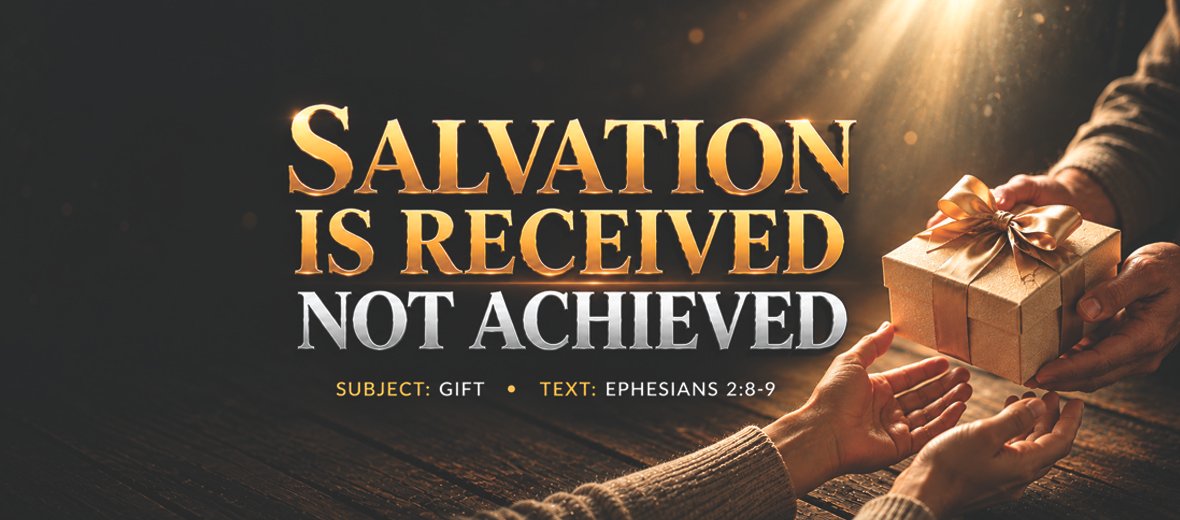
There are moments when the most important thing we can do is stop trying to prove that we are worthy and simply receive what has already been offered to us. Many people struggle with their relationship with God because somewhere along the way, they began to believe that salvation is something they must accomplish, maintain, or continually earn. They pray, serve, give, attend church, help others, and try to live good lives, yet deep inside they still wonder, “Have I done enough?” If you have ever asked yourself that question, Ephesians 2:8-9 speaks directly to your heart:
“For it is by grace you have been saved, through faith, and this not from yourselves, it is the gift of God, not by works, so that no one can boast.”
Salvation Is a Gift, Not an Achievement
Paul could not have made the message clearer. Salvation comes by grace, through faith, and it is the gift of God. It does not originate with us, and it cannot be earned through our works. This means that salvation is something we receive rather than something we achieve. A gift does not become ours because we worked hard enough to deserve it. Someone gives it, and we receive it. In the same way, God offers salvation through Jesus Christ, and our response is to receive it by faith.
Receive It as an Act of Dependence
Receiving salvation is an act of dependence. When you receive something from another person because you cannot provide it for yourself, you are admitting that you need help. Salvation requires that same humility. You are acknowledging that no amount of personal goodness, religious activity, or human effort can rescue you from sin. No one in their right mind would refuse help from someone who has the ability and willingness to provide what they desperately need, yet sometimes we do exactly that spiritually because we keep trying to save ourselves.
Finding Assurance in God’s Promise
Perhaps this is why some people continue to struggle with assurance. They have heard the gospel, but they have never fully embraced salvation as God’s gift. They continue asking whether they have prayed enough, served enough, obeyed enough, or done enough good things to qualify. But how many good works are enough to gain salvation? Where would we even draw the line? If salvation depended upon reaching a certain number of good deeds, none of us could ever have complete assurance because we would always wonder whether we had done enough.
God does not ask you to calculate whether your good works have finally outweighed your failures. He asks you to trust His Word. When Scripture says salvation is a gift, believe Him. When God says that salvation comes through faith and not through works, rest in that promise. God cannot lie, and your assurance cannot be built upon the changing measurement of your performance. It must rest upon the faithfulness of the One who gave the gift.
Good Works Are a Response to Grace
That does not mean good works are unimportant. It means we must understand their proper place. We do not do good works so that God will finally save us. We do good because we have already received His grace. Gratitude becomes the natural response to a gift we could never earn. When you truly understand what Christ has done for you, obedience is no longer an attempt to purchase God’s love. It becomes a response to the love you have already received.
Receive It Without Trying to Repay It
This is an important distinction because many Christians quietly live as though they owe God a debt that must somehow be repaid. They think, “God saved me, so now I must work hard enough to make it up to Him.” Others live with the fear that if they stop doing enough, God will take salvation away from them. This way of thinking can turn the Christian life into a constant attempt to settle a debt that Christ has already paid.
The idea of needing to maintain salvation as though we must continually repay God can resemble the old religious concept associated with indulgence, or what we might describe as utang na loob, a deep sense of indebtedness that creates an obligation to repay a favor. But salvation is not a transaction in which we eventually settle the account with God. Christ paid the debt completely. Our response is not compensation but gratitude.
Romans 13:8 gives us a helpful perspective:
Owe nothing to anyone, except for your obligation to love one another. If you love your neighbor, you will fulfill the requirements of God’s law.
The Christian life is therefore not about spending the rest of our lives trying to repay God for saving us. We cannot repay what Christ has done. Instead, His grace changes the way we live, and that transformed life becomes an expression of love toward God and toward others.
Serving God Out of Gratitude, Not Obligation
-
Think about what this means for the things we do as Christians.
-
Our worship every Sunday should not be an attempt to repay God for salvation.
-
Our giving should not be an effort to purchase His continued favor.
-
Our participation in prayer meetings, care groups, fellowships, ministries, and other acts of service should not come from fear that we will somehow lose God’s acceptance if we do not do enough.
-
These things are meant to flow from gratitude for what God has already done.
We do the will of God because we love Him, not because we are trying to earn what He has already freely given.
There is tremendous freedom in understanding that difference. When you serve God because you are trying to prove yourself, even good things can become exhausting. You begin measuring yourself against other people. You wonder whether your service is enough. You may even become discouraged when no one notices what you are doing. But when your service flows from gratitude, the focus changes. You are no longer performing for acceptance. You are responding to grace.
This is also why everything we do for the Lord must be done in humility. Even our acts of worship can lose their proper purpose when our hearts become filled with pride. We can sing, give, serve, pray, teach, and participate in ministry while quietly believing that these things make us more deserving of God’s favor. Yet the gospel continually brings us back to the same truth: we are saved because of what Christ has done, not because of what we have accomplished.
Receive It and Live in It Daily
But receiving salvation is not simply something that happens once and then becomes a distant memory. Salvation is a gift to be enjoyed, cherished, and lived in every day. It changes the way you see yourself, the way you approach God, and the way you live in the world. Galatians 3:27 says, “And all who have been united with Christ in baptism have put on Christ, like putting on new clothes.” Paul uses the picture of putting on new clothes to describe what happens when we are united with Christ. Something has changed about who we are.
Second Corinthians 5:17 says, “This means that anyone who belongs to Christ has become a new person. The old life is gone; a new life has begun!” Salvation is not simply a ticket to heaven that we keep in our pocket while continuing to live exactly as before. God’s gift brings new life. It gives us a new identity and calls us to walk differently because we now belong to Christ.
This is why we should receive the gift of righteousness that comes from God through salvation and allow it to shape the way we live. Think of it as something you wear each day. When you believe in Christ and walk in the righteousness that comes from Him, you begin to experience the life He has provided. Your salvation is not something you should continually question based on whether you have performed perfectly. It is something you should treasure and allow to transform your daily life.
Perhaps the question we need to ask ourselves is not, “What more must I do to earn God’s salvation?” but, “How should I live now that God has already given me this gift?” That question changes everything. It moves us away from fear and toward gratitude, away from striving and toward dependence, and away from pride and toward humility.
God’s gift of salvation is not something to admire from a distance, debate endlessly, or postpone until later. It is a gift to be received personally, completely, and joyfully. The hands of grace are extended toward you, not because you have finally become worthy, but because God is gracious. You do not need to bring Him a list of accomplishments before you come. You need to come in faith and receive what He has freely given through Christ.
Let us pray.
Heavenly Father, thank You for the gift of salvation that we could never earn for ourselves. Forgive us for the times when we have tried to prove our worth or repay what Christ has already accomplished. Teach us to trust Your Word, rest in Your promises, and receive Your grace with humility and gratitude. Help us to live each day as people who belong to Christ, allowing His righteousness to shape our thoughts, choices, relationships, and actions. May everything we do for You flow from love and thanksgiving rather than pride, fear, or an attempt to earn Your favor. Thank You that salvation is Your gift, given through Christ and received by faith. In Jesus’ name, Amen.
The gospel gives us a truth that is both humbling and freeing: salvation is not a trophy waiting for those who perform well enough. It is the gift of God, received through faith. You cannot achieve what God has chosen to give. You cannot repay the price Christ has already paid. What you can do is receive His gift, trust His Word, live in the righteousness He provides, and allow gratitude to shape the way you follow Him each day.
The question is no longer whether you have done enough to deserve salvation. The deeper question is whether you are willing to stop trying to earn what God is asking you to receive. Have you truly received God’s gift of salvation through faith, or are you still trying to achieve what Christ has already accomplished for you?